Proposals 2026-2028
Projects planned and tracked under the Cardano 2026/2028 proposal stream.
Program Overview
Proposal overview
While much of our 2025 effort focused on projects aimed at future improvements, our main strategic direction for the 2026-2027 proposals is threefold:
- The primary focus for our 2026 proposals is the successful launch of Peras to the mainnet, alongside preparing other ongoing projects for the integration of both Peras and Leios.
- Ensuring all our development work reaches the mainnet, is adopted by the community, and is in synergy with other strategic initiatives across the Cardano Ecosystem.
- All our development efforts are continuously vetted against the ongoing work of Input Output Global (IOG) and other ecosystem contributors to ensure maximum synergy. This includes proactive participation in community governance, technical workshops, and standards discussions to guarantee that Tweag’s deliverables are not just technically sound but also strategically aligned with the overall roadmap for Cardano.
Project budget
Total ask: ₳39,787,316.00
(including subcontracts and the work excluded from the 2025-2026 work).
Time: 2 years.
Work Packages Summary
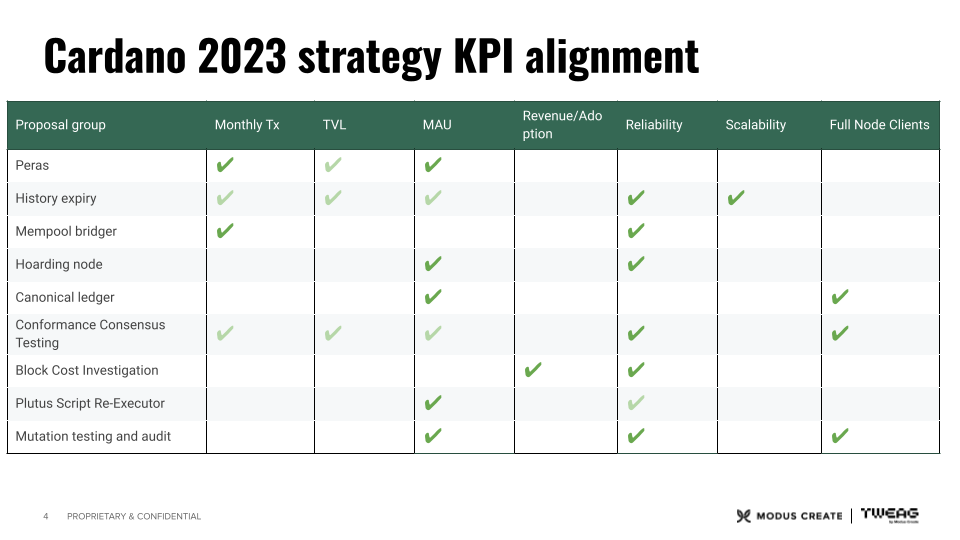
Primary and secondary signals used in this table:
 Primary metric
 Secondary metric
| Project | Monthly TX | TVL | MAU | Reliability | Scalability | Revenue | Alt. Node Clients | Description |
|---|---|---|---|---|---|---|---|---|
| Peras: delivery to the mainnet and suppport | | | | A protocol that enables faster settlement in Cardano network. | ||||
| History expiry | | | | | Support for partial nodes that only store recent history. Descrease SPO costs.Download full proposal | |||
| Hardfork mempool bridger | | | A mempool bridge that allows users to submit transactions during hardforks.Full description | |||||
| Conformance Testing of Consensus | | | | | | A testing framework for consensus protocol that can be used by all node implementors.Leios and Peras supportGenerate forks from adversarial branches | ||
| Hoarding node | | | A node that allows users to collect real observability data and submit it to a shared database for analysis.Live nodeDistributed modeEmbedded header validationTransaction collection | |||||
| Canonical Ledger State: ecosystem integration | | | A project to integrate the canonical ledger state into the ecosystem.Download proposal | |||||
| Plutus Script Re-Executor | | | Extensions for the Plutus Script Re-Executor: a tool providing a script shadowing mechanism that increments their execution visibility.Download proposal | |||||
| Mutation Testing framework | | | | Generic mutation testing framework.Download proposal | ||||
| Block cost investigation | | | Research project to investigate an execution cost model for block production. | |||||
| Maintenance and support GSA, cardano-node-emulator | | | Research project to investigate an execution cost model for block production.cardano-node-emulator support |
Secondary Metrics Notes
The secondary metrics in this table highlight meaningful expected impact, but not the primary delivery objective of the work package.
- Peras: delivery to the mainnet and suppport creates the conditions for DApps to use Cardano more effectively, even if it does not directly increase those metrics on its own.
- History expiry supports Peras and Leios on the network and can help reduce SPO costs associated with new features, without requiring major changes to existing protocols.
- Conformance Testing of Consensus supports both Haskell and alternative node implementations, especially in the context of Peras and Leios.
- Plutus Script Re-Executor has reliability as a secondary metric because it improves script optimization and monitoring rather than acting as a direct reliability project.
FAQ
Why is this a single bundle rather than individual proposals?
We want to be transparent about where we stand and why we are bringing this forward now.
The shortfall of approximately 3.5M USD is not the result of mismanagement or undelivered work, it is a direct consequence of ADA’s market movement between our treasury award and the point Intersect needed to convert to fiat. That gap is already being absorbed by us. We have self-financed critical work since November 2025 to keep the most important roadmap deliveries on schedule.
The proposal we are putting forward covers the full scope needed to complete what we committed to work that is directly aligned to the Cardano roadmap milestones already publicly tracked. We are not proposing to split it into phases, because doing so would introduce delivery risk over the 18 months ahead and undermine the continuity this work requires.
We have been building in this ecosystem since 2018. The delivery record is public. We are asking the community to look at what has been built and decide whether it is worth completing.
Why two years? Why not deliver faster?
Peras requires a Hard Fork (HF) event to reach mainnet, and HF events happen on a fixed cadence. If the work is completed too early it sits idle waiting for the next window. The two-year plan phases delivery so Peras v1 lands at the right HF moment, and Peras v2 work begins immediately in parallel. The duration reflects the HF cycle, not padding.
What exactly is Tweag’s track record? Have they delivered before?
Tweag has been engaged with IOG on Cardano core infrastructure since January 2018. They led the consensus and ledger teams, implemented the Ouroboros Genesis protocol, and contributed to the design of Ouroboros Peras.
What is the ₳39.8M actually paying for?
The total breaks down to approximately 0.25/ADA weighted average rate calculated over five years. Each work package has an FTE estimate and cost breakdown in the full proposal document. The largest single items are Peras v1 (₳4.95M including CBU research support), Peras v2 (₳8.24M including CBU research support), and the Plutus Script Re-Executor (₳4.36M).
What happens if ADA price rises significantly?
We will only ever withdraw up to the maximum USD amount specified in our proposal. If the ADA/USD rate moves in our favour, we will not take advantage of that to withdraw more than originally requested.
What happens if ADA price falls?
We have selected 0.25 USD ADA ratio as this is the current rate. If the prices changes drastically, we will ask the community for priority. We will try to deliver maximum and critical parts of the proposal. Working with Intersect we planned that conversion from ADA to Stablecoins is done faster, so even if there is a drop. We don’t see a big change in price.
What does success actually look like for Peras? How will we know it worked?
For Peras as well as for other projects we have clearly written measurable success criteria that will be checked.
To be precise with Peras we expect to measure if settlement will be improved to the level comparable with the theoretical improvements expected by the Research Papers.
What is the Hoarding Node and why does it need four separate work packages?
Hoarding node is an observability tool that allows to monitor the network and find anomalies or adversarial behavior, as on the main chain as well as on the branches. The project is split into 4 distinct work packages, because each package has it’s own value for the Cardano network as well as success criteria. Instead of making it a single package, with milestone per paсkage and all metrics mixed, we have decided to note that explicitly for the greater visibility.
Why is Tweag maintaining the Cardano node emulator? Shouldn’t IOG handle that?
The Cardano node emulator (CNE) was left without active maintenance. It’s a critical tool for smart contract developers, it allows testing Plutus contracts without running a full node. Tweag picked up maintenance in 2025 and is proposing to continue because no other party has stepped up. The proposal is transparent that this is maintenance work, not new feature development.
What is the relationship between this proposal and IOG’s ongoing work?
The proposal commits to continuous vetting against IOG’s ongoing work and other ecosystem contributors. Tweag maintains dedicated internal communication channels and a program-level Slack for cross-team coordination. Several work packages, including conformance testing, canonical ledger state, and history expiry, require direct collaboration with IOG teams and Mithril. Tweag’s role is to deliver work that integrates with and complements rather than duplicates IOG’s efforts.
How will the community stay informed throughout delivery?
Weekly project updates and public demos at minimum every two months are published at tweag.github.io/cardano-website. A dedicated Discord channel is maintained for all projects.
For work requiring interaction with core teams, advance design discussions and integration alignment are built into the delivery process. Intersect serves as auditor of record, verifying that deliverables align with commitments.
What happens if a work package doesn’t deliver?
Tweag is requesting milestone based fixed price contracts with Intersect as administrator. Funds are released against milestones, not upfront. Each milestone has defined deliverables and explicit acceptance criteria. If a milestone is not met, the next payment is not triggered.
How does this align with the Cardano 2030 Vision?
All of the projects correlate with core KPI and vision of the projects. Each package have Expected Value section that explains the relationship in details. You can find a short version here here.
What’s the contingency if Peras v1 is delayed past its Hard Fork window?
While we are trying to address make this situtation not happen by working on this proactively. But in a case of this happending the actions do not depend on Tweag solely.
This question will require wider community agreement on the strategy wether to wait for the next window or to delay the HF. From our side we work on making most to ensure safe and prompt code delivery.
Has the community been tracking your 2025 delivery, and where can they see proof?
Yes, across several channels:
- Intersect milestone reporting: We submit Milestone Acceptance Forms (MAFs) for every completed milestone as part of our Intersect contract. These are reviewed and signed off before the next payment is triggered. Delivery is verified, not self-reported.
- Project website: Status updates for every active work package are published at tweag.github.io/cardano-website throughout the cycle.
- GitHub: All code is open source. Commit history and merged pull requests provide a timestamped record of what was built and when.
- Demos: Public demos at least every two months, recorded and archived on the project website.
- X: Progress updates and milestone completions shared publicly.
Do you have a full team or do you need to hire additional developers?
Tweag have a team that is ready to deliver all the projects, so no additional hires required.
Though may want to make additional hires for speeding projects up in case if it makes sense from the delivery perspectives.
What happens if the vote does not pass?
The situation with ADA price drop in 2025 has hit the company, at this point we continued development of the projects from our own budget. But it can’t continue indefinitely, in case if vote didn’t not pass Tweag will not be able to support delivery of the projects outside of the 2025 proposals scope.
See more elaborated statement
I am not a technical person, this is too complicated for me to understand, Can you boil it down for me? Why is Cardano worse if we do not fund you?
Right now Cardano takes about 12 minutes to confirm a transaction is final. Peras brings that down to 2-5 minutes. That matters for anyone building apps, running DeFi protocols, or using Cardano in the real world. Without this funding, Peras does not reach mainnet.
Beyond Peras, as Cardano processes more transactions, running a node gets more expensive. History Expiry keeps that cost manageable for stake pool operators. Without it, fewer people can afford to run nodes, which weakens decentralisation.
The hoarding node is the network’s early warning system. It watches for attacks and unusual behaviour that normal nodes miss. Without it, the community has less visibility into what is happening on the network.
The testing and tooling work is less visible but just as important. It is what catches bugs before they become incidents. The June 2024 network disruption is an example of what can happen when worst-case scenarios are not tested properly.
Tweag has been doing this work since 2018. This proposal is the continuation of that, focused on getting everything across the line to mainnet rather than back to the drawing board with a new team.
How does this go with the IOG proposals? Is it competing with them? Or something completely different?
Tweag and IOG work on separate, but complementary scopes. Leios and Peras go hand in hand. Several of our packages require direct collaboration with IOG teams and we coordinate closely to avoid duplication. One team can’t deliver everything, and this is consciously parallel effort to build faster.
Not competing. Building together.